
How to Help a Scared or Shy Cat Gain Confidence: A Complete Guide
Many cat owners have encountered this scenario: a newly adopted cat darts beneath the bed the moment anyone enters the room, or a longtime companion freezes with wide, dilated eyes at the slightest unfamiliar sound. Fearfulness in cats is far more common than people realise — but with patience, the right environment, and some evidence-based techniques, even a deeply shy cat can learn to feel genuinely safe and confident.
Why Are Some Cats Fearful or Shy?
Fearfulness in cats rarely has a single cause. Veterinary behaviorists consistently find that it emerges from a combination of genetics, early life experiences, and later trauma or illness.
Genetics and the Socialization Window
Some cats are simply born with a more reactive temperament — a nervous system that responds more intensely to novelty, regardless of how they are raised. However, early socialization plays a critical role for every cat. Kittens have a sensitive socialization window roughly between 2 and 9 weeks of age, during which positive exposure to people, other animals, sounds, and environments shapes their baseline comfort level for life. Kittens who receive little human contact during this period, or who experience distressing events, are significantly more likely to grow into anxious adults.
Trauma and Negative Associations
A single frightening event — a loud noise, a rough handling incident, or a threatening animal — can leave a lasting imprint on a cat’s emotional responses. VCA Animal Hospitals notes that one traumatic experience can generate a generalized fear response, meaning a cat may become wary in many unrelated situations, not just the original context that triggered the fear.
Medical Factors
Pain and illness also contribute substantially to fearfulness. Any cat that is physically uncomfortable may become defensive or withdrawn as a result. If a previously confident cat suddenly becomes shy or reactive, a veterinary check-up is the essential first step to rule out an underlying health issue before addressing behavior.
Recognizing the Signs of a Fearful Cat
Fear presents differently depending on its intensity. Common signs include:
- Hiding more than usual or refusing to emerge for extended periods
- Crouching, flattened ears, and a low or tucked tail when approached
- Dilated pupils and a tense, hunched posture in the presence of a perceived threat
- Hissing, swatting, or biting when the cat feels cornered with no escape
- Changes in appetite or litter box habits in chronically anxious cats
- Excessive grooming or other repetitive self-soothing behaviors
It is worth distinguishing between a cat that is temporarily startled and one living in a state of persistent anxiety. The latter needs consistent, structured support rather than occasional reassurance.
Setting Up a Safe Space
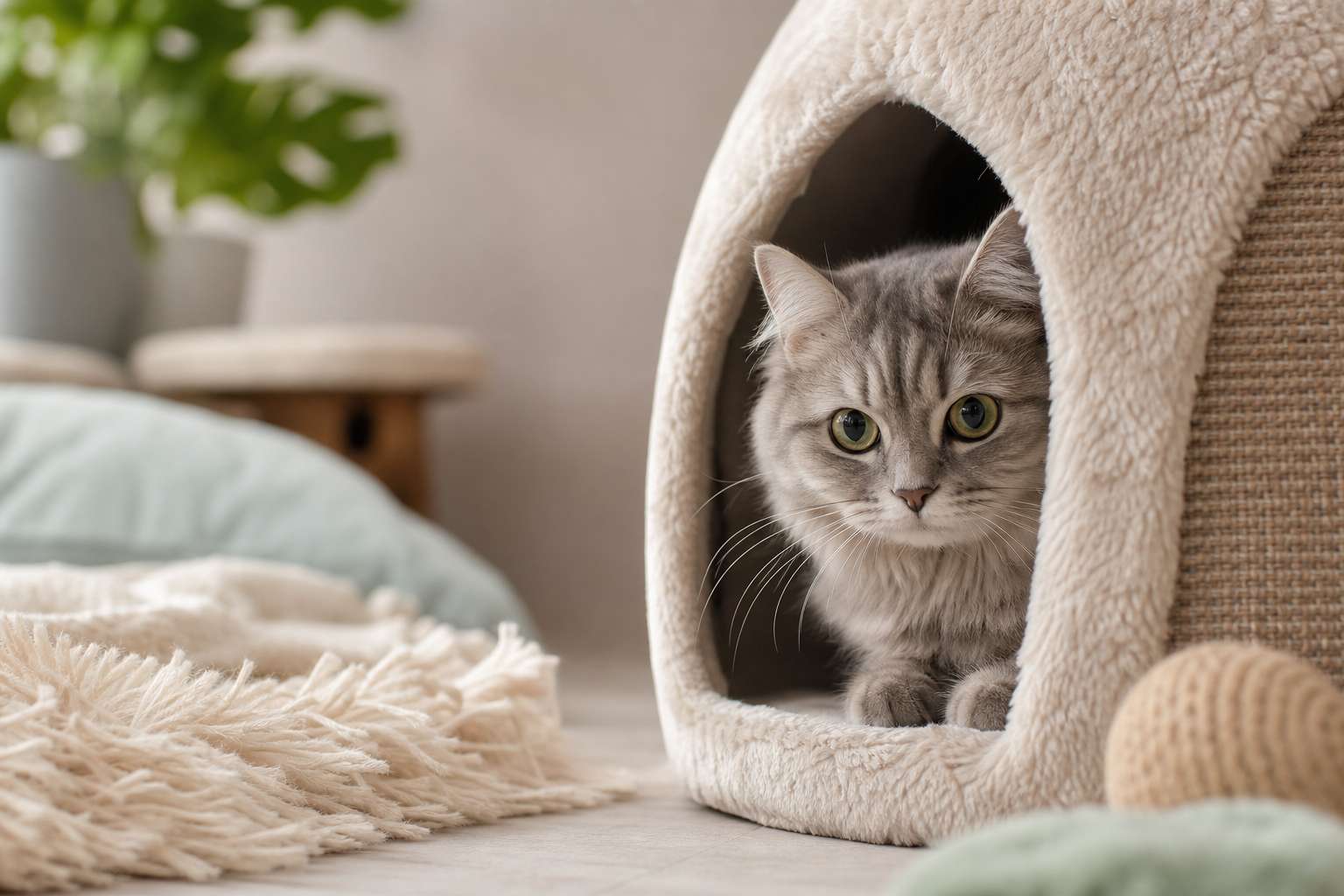
The single most effective first step for a shy or newly adopted cat is providing a dedicated safe room: a small, quiet space containing everything the cat needs — food, water, a litter box, a comfortable bed, and hiding options such as a cardboard box on its side or a covered cat tent. For a cat already overwhelmed by the world, a smaller territory is actually less stressful than an expansive, unpredictable one. As one pet resource puts it, for a skittish cat a large domain can be overwhelming.
Hiding spots deserve special emphasis. Many well-meaning owners remove a cat’s hiding places hoping to encourage interaction — but this is counterproductive. A cat that can choose to hide feels safer, and a cat that feels safe is far more likely to come out voluntarily. Always ensure your cat has an accessible exit route, and never back a fearful cat into a corner.
Let the Cat Lead Every Interaction
The most important principle in building trust with a shy cat is allowing the cat to control the pace of any interaction. Maddie’s Fund advises owners to sit quietly in the cat’s space and let the cat approach on its own terms, rather than reaching out or making prolonged direct eye contact, which cats can read as a threatening gesture.
A few practical habits make a meaningful difference:
- Get low. Sitting or lying on the floor is far less intimidating to a small animal than a large figure looming overhead.
- Offer a slow blink. Squinting slowly in a calm cat’s direction is a well-documented signal of non-threat in feline communication.
- Extend a single finger rather than a full hand. Letting a cat sniff one finger gives them control over the encounter from the start.
- Keep your voice quiet and even. Avoid sudden sounds or movements that trigger a startle response.
Positive Reinforcement and Play
Once your cat is eating well and using the litter box reliably — reliable indicators that baseline stress has lowered — you can begin building positive associations with your presence through food and play.
High-value treats such as small pieces of cooked chicken or quality commercial cat treats can be dropped near where the cat is resting, so it begins to connect your approach with something good. Over multiple sessions, you can gradually shorten the distance between you and where the treat lands. San Diego Humane Society calls this a treat-drop technique — a simple but powerful form of counterconditioning that works incrementally.
Interactive play with a fishing-rod-style toy is particularly useful because it lets a cat engage with you while maintaining comfortable physical distance. Play activates the brain’s reward pathways, and a cat actively engaged in a mock hunt cannot simultaneously sustain a fear state. Short, regular sessions of 10 to 15 minutes help the cat associate your presence with fun rather than threat.
Desensitization and Counterconditioning
These two techniques, commonly used together, form the backbone of behavior modification for fearful cats. Desensitization means systematically exposing a cat to a frightening trigger at such a low intensity that it does not provoke a fear response — then increasing that intensity very gradually across many sessions. Counterconditioning means pairing that mild version of the trigger with something the cat loves, so the emotional association shifts from fear to positive anticipation.
For example, if your cat is terrified of strangers, you might begin by having a visitor sit silently in another room while your cat receives high-value treats. Over weeks, the visitor moves progressively closer — always at a pace the cat can tolerate without showing stress signals. VCA Animal Hospitals recommends keeping initial sessions to 10 to 15 minutes and always ending while the cat is still comfortable, before it reaches its stress threshold.
Environmental Calming Aids
Several tools can reduce background anxiety while behavioral work is underway:
- Synthetic feline pheromone products — available as plug-in diffusers, sprays, or collars — mimic the calming facial pheromones cats deposit when they rub their faces on objects they consider safe. Studies have supported their usefulness in reducing stress-related behaviors in cats.
- Consistent routine. Feeding at the same times each day, keeping furniture arrangements stable, and limiting unexpected visitors during an adjustment period all reduce the cognitive load on an anxious cat.
- Vertical space. Cat trees and wall-mounted shelves give shy cats the option to observe the room from above. Height provides both psychological distance and a sense of control over the environment.
When to Involve a Veterinarian or Behaviorist
If your cat’s fearfulness is severe — involving aggression, near-total social shutdown, or making the cat visibly miserable despite weeks of patient effort — a veterinary consultation is the right move. A vet can rule out medical contributors and, where appropriate, discuss pharmaceutical support. Options such as gabapentin for situational stress or longer-acting medications for chronic anxiety can meaningfully reduce a cat’s fear baseline, making behavioral work possible where it might otherwise stall. According to PetMD, treatment for chronic feline anxiety typically requires a minimum of four to six months and may need to continue long term.
For complex cases, board-certified veterinary behaviorists and certified feline behavior consultants offer structured, personalized programs that go well beyond what general resources can provide.
FAQ
How long does it take for a shy cat to come around?
There is no universal timeline. Some cats begin to relax within a few days of arriving in a calm, cat-friendly home; others may take months of consistent, patient work. Chronically traumatized cats may always be somewhat reserved, but even they can reach a place of genuine security and enjoy moments of connection on their own terms.
Should I force my cat to interact to help it get used to people?
No — and this is one of the most common mistakes owners make. Picking up a cat against its will, blocking escape routes, or holding it while it struggles does not build confidence. It increases fear and destroys trust. Research consistently shows that consent-based, force-free approaches produce lasting improvement, while forced handling tends to make cats more fearful over time, not less.
Can a feral or semi-feral cat ever become affectionate?
Some can, but it depends heavily on early socialization history and individual temperament. Cats that had minimal human contact before 9 weeks of age may never become lap cats — but many will reach a comfortable equilibrium with their caregivers, enjoying life at a safe distance. Progress on the cat’s own terms is always worth celebrating, even if it never looks like the cuddly ideal.
Is a shy cat ever simply introverted rather than anxious?
Yes. Just as human personalities vary widely, cats exist on a broad spectrum of sociability. A cat that prefers independent living with minimal handling is not necessarily suffering — provided it is eating well, playing when alone, and showing no physical signs of chronic stress. The goal is always the cat’s wellbeing and quality of life, not conformity to a social standard.
Sources
- vcahospitals.com
- maddiesfund.org
- sdhumane.org
- petmd.com
- vcahospitals.com
- litter-robot.com
- icatcare.org
- jacksongalaxy.com