
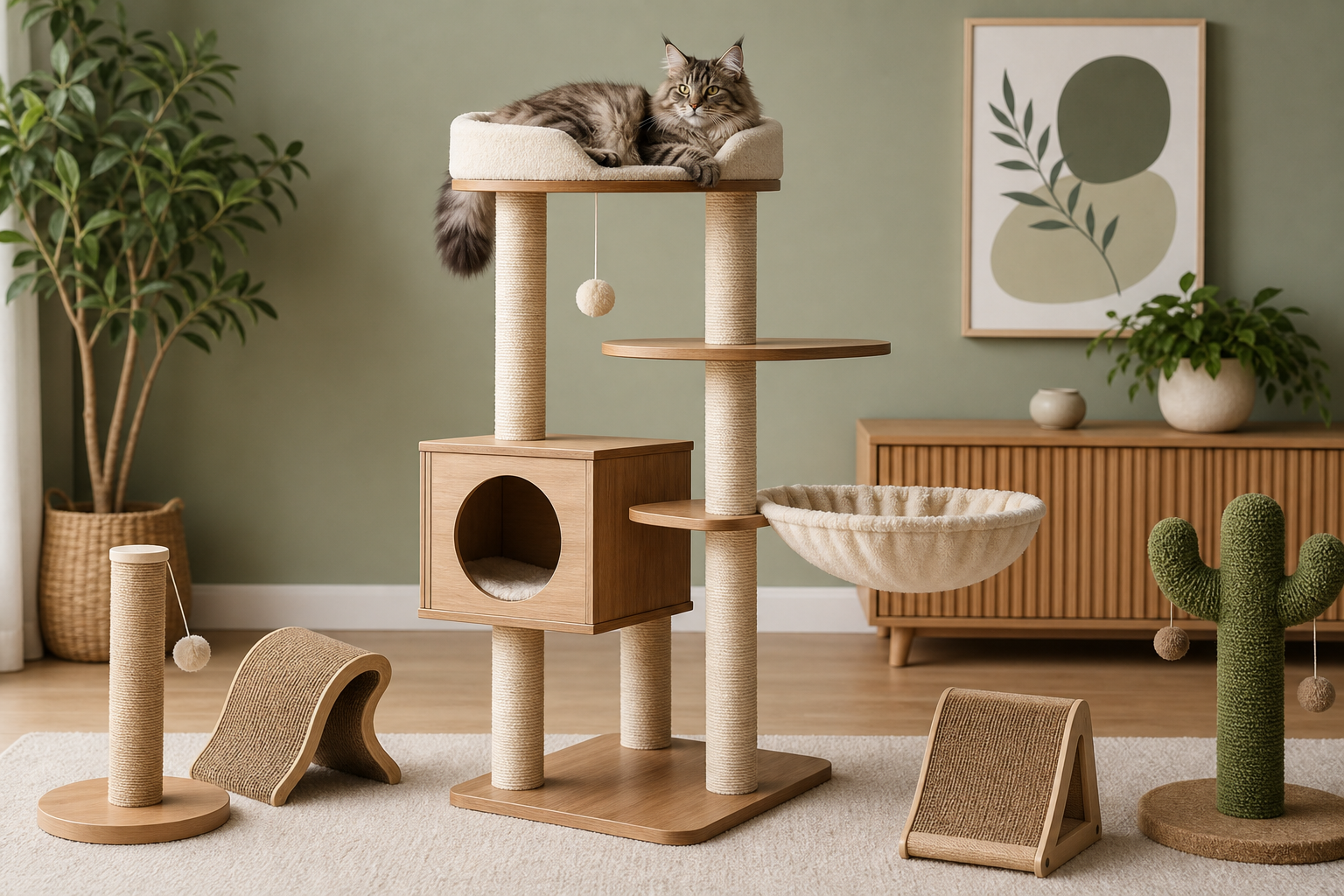
Cat Trees, Towers, and Scratching Posts: What to Look For
If your sofa has seen better days, you already know that a cat without a proper scratching outlet will find one on its own terms. Cat trees, towers, and scratching posts are far more than pet accessories — they’re tools that directly support your cat’s physical health, mental wellbeing, and natural communication instincts. Knowing what to look for makes the difference between a piece of furniture your cat ignores and one that becomes the center of its world.
Why Cats Scratch in the First Place
Before choosing any cat furniture, it helps to understand the behavior you’re trying to support. Cats scratch for three interconnected reasons: claw maintenance, physical exercise, and territory marking. According to veterinary guidance from VCA Animal Hospitals, scratching helps cats shorten and condition their claws by removing the dead outer nail sheaths — a form of self-grooming that keeps claws sharp and healthy. At the same time, the act of reaching up and dragging claws downward is a full-body stretch that engages muscles, limbers joints, and satisfies a deep physical need.
The territorial dimension is equally important. Cats have scent glands between their paw pads, and scratching deposits pheromones onto surfaces — essentially leaving a personalised message for other animals (and themselves). Visible scratch marks also serve as a visual signal. Cats Protection, the UK’s largest feline welfare charity, notes that when a cat scratches in multiple spots near windows and doors, it is often communicating anxiety about its environment, not simply acting destructively. Providing appropriate outlets for this behavior isn’t a luxury; it’s a welfare essential.
Cat Trees, Towers, and Scratching Posts: What’s the Difference?
These terms are often used interchangeably, but they describe distinct products:
- Scratching posts are the simplest form — typically a single vertical or horizontal surface wrapped in a scratchable material, designed purely for claw maintenance and stretching.
- Cat towers are taller, multi-level structures that combine scratching surfaces with climbing platforms, and sometimes condos (enclosed cubbies) or hammocks. They prioritise vertical space.
- Cat trees tend to be wider, branching structures that mimic the spatial variety of a real tree — multiple platforms at different heights, often with scratching posts integrated into the trunks. The distinction from towers is loose, and many products use the terms interchangeably.
All three serve overlapping purposes, and the right choice depends on your cat’s personality, your living space, and how many cats share your home.
The Non-Negotiables: Stability and Height
Two features matter above all others, and cutting corners on either one will almost guarantee your cat ignores — or is frightened by — the new furniture.
Stability is the single most important factor in whether a cat will use a scratching post or tree. A post that wobbles or tips when your cat leans into it will be abandoned immediately, and could cause injury. Look for a wide, heavy base, thick central posts, and tight construction. For freestanding towers taller than around 60 inches, many manufacturers recommend anchoring the unit to a wall stud with an included bracket or hardware you source yourself.
Height is equally critical. Scratching is most effective and satisfying when a cat can fully extend its body — rising on its hind legs and reaching upward. A post that requires a cat to crouch provides a poor stretch and won’t be chosen over the arm of your sofa. The Just Cats Clinic recommends posts long enough for a full-body extension, which for most adult cats means at least 30 to 32 inches for a standalone post. Multi-level towers typically exceed this comfortably.
Scratching Materials: Sisal, Cardboard, Carpet, and Wood
The surface material is what determines whether the scratch feels right to your cat. Different textures appeal to different individuals, so understanding the options helps you make an informed first choice — and know when to try something different.
Sisal is the most widely recommended material for scratching posts and the posts integrated into cat towers. It’s a natural plant fiber that is tough, durable, and has a texture that allows cats to dig in and tear satisfyingly without their claws getting snagged. Catster notes an important distinction: sisal fabric tends to outperform sisal rope over time, because rope develops grooves as it wears and can produce uncomfortably sharp fiber ends, whereas fabric softens into smooth fibers as it’s used.
Corrugated cardboard has a loyal following among cats who love the sound and the pliable resistance it provides. The downside is durability — cardboard scratchers generate debris and wear out significantly faster than sisal. They work particularly well as horizontal pads or angled inserts placed at floor level.
Carpet is the traditional covering for cat trees and is fine for climbing platforms and condos, but less ideal as a primary scratching surface. Cats can get their claws caught in looped carpet fibers, and if the carpet texture resembles your home’s flooring, it can inadvertently encourage unwanted scratching elsewhere. If a cat tree includes carpeted posts, pairing it with a sisal post nearby is a sensible approach.
Wood — particularly rough or natural timber — appeals to many cats and is extremely durable. Some premium cat furniture uses real wood posts for this reason.
Platforms, Perches, and Vertical Space
For cat trees and towers specifically, the arrangement of platforms and perches is what makes the piece genuinely enriching rather than merely functional. Cats are hardwired to seek high vantage points: in the wild, elevation provides a view of predators and prey alike, and the instinct runs deep even in pampered indoor cats. A perch near a window isn’t just cozy — it provides visual stimulation, a form of mental enrichment that helps prevent the boredom and frustration that often leads to destructive behavior.
Look for structures with multiple platforms at varying heights, so cats can choose their comfort level. Enclosed condos or cubbies on lower or mid levels give anxious or shy cats a place to retreat and feel hidden. Hammocks add resting variety. Dangling toys integrated into the structure offer play, though many cats ignore these once the novelty fades, so they should be a bonus rather than a deciding factor.
Matching the Furniture to Your Cat’s Specific Needs
A one-size-fits-all approach rarely works with cat furniture. Consider these variables:
- Multiple cats: Each cat benefits from having its own scratching surface and its own perch. Shared structures should have enough platforms that no single cat can monopolise the high spots, which are prime real estate in a multi-cat home.
- Large or heavy cats: Standard cat trees typically support 15–25 lbs per platform. Larger breeds like Maine Coons or Ragdolls may need structures rated for 30–40 lbs per level, with correspondingly thicker posts and sturdier bases.
- Senior cats: Older cats with reduced mobility or joint issues benefit from lower structures, or towers that include shallow steps or ramps between levels rather than wide, open jumps.
- Scratching style: Observe where and how your cat already scratches. A cat that digs into the arm of your sofa likely prefers a horizontal or low-angled surface. A cat that reaches up walls or door frames will gravitate toward tall vertical posts. Providing both orientations covers most preferences.
Placement: The Most Overlooked Factor
Even the best-constructed cat tree will collect dust if it’s tucked in a corner of a rarely-used room. Cats scratch in socially significant locations — near sleeping spots, by entry points, and in areas where they spend the most time. Placing a post next to a sofa your cat already targets, or positioning a tower beside a sunny window, dramatically increases the chance of adoption. Petmate’s animal behavior guidance emphasises placing posts near where cats already sleep as one of the most reliable strategies for encouraging use.
If you’re introducing new furniture to redirect an existing scratching habit, positioning the new post directly beside the problem surface — then gradually shifting it to a more suitable spot over several weeks — is more effective than simply removing access to the old location.
FAQ
How tall should a cat scratching post be?
A scratching post should be tall enough for your cat to fully extend its body while standing on its hind legs — for most adult cats, a minimum of 30 to 32 inches. A post that’s too short forces a crouch, which defeats the stretching purpose and makes the post less appealing than your furniture.
Is sisal rope or sisal fabric better for scratching posts?
Both are popular, but sisal fabric is generally considered superior for longevity and comfort. Sisal rope develops grooves and sharp fiber ends as it wears, while fabric breaks down more smoothly. That said, individual cats may prefer either — if your cat ignores a fabric post, trying a rope-wrapped alternative is a reasonable next step.
My cat ignores the scratching post. What should I do?
First check placement — the post may be too far from where your cat naturally spends time. Next, consider the material and orientation; some cats strongly prefer horizontal surfaces over vertical ones, or vice versa. Sprinkling a small amount of catnip on the post or rubbing it with a silvervine stick can spark initial interest. Avoid forcing your cat’s paws onto the post, as this tends to create a negative association rather than enthusiasm.
Do cats really need vertical space, or is a floor-level scratching pad enough?
For many cats, especially active or anxious individuals, vertical space is a genuine welfare need rather than a nice-to-have. High perches allow cats to survey their territory, feel secure, and retreat from perceived threats — including household commotion or other pets. A floor-level scratcher addresses claw maintenance but does not replicate the security and mental stimulation that a taller structure provides.
Sources