Cat Toys and Enrichment: How to Keep Your Indoor Cat Active and Happy
Indoor cats enjoy longer, safer lives than their free-roaming counterparts — but safety alone doesn’t make a life fulfilling. Without the mental and physical challenges the outside world provides naturally, many cats grow bored, anxious, or quietly unhappy, and their owners are often left puzzled about why.
Why Indoor Life Creates a Stimulation Gap
A domestic cat’s brain and body are exquisitely engineered for hunting. Even a thoroughly well-fed cat experiences a powerful, persistent drive to stalk, pounce, and capture prey — a drive that operates entirely independently of hunger. Veterinary behaviorists note that cats are biologically wired to spend a substantial portion of their waking hours in active predatory behavior, cycling between careful stalking and short, explosive chases.
When indoor cats cannot express these instincts, the energy doesn’t simply evaporate. It tends to redirect itself in ways owners find baffling or frustrating: furniture shredded at three in the morning, litter box accidents, unprovoked aggression toward other pets, or a relentless loop of vocalization. These are often not personality flaws — they are symptoms of an unmet biological need. Thoughtful enrichment, combining structured play, environmental variety, and mental challenge, can address that need almost entirely.
Understanding the Hunt: What Cats Actually Need from Play
Effective enrichment starts with understanding how cats hunt. The natural predatory sequence moves through distinct phases: orient, stalk, chase, pounce, catch, and then consume. Each step matters. Play sessions that skip straight to the swatting phase, without room for stalking and anticipation, feel incomplete and can leave a cat more wound up than satisfied.
This is why interactive wand toys — long-handled toys with feathers, fabric tails, or small stuffed figures on a line — are consistently recommended by veterinarians and animal behaviorists. Controlled by a human, they can mimic the unpredictable, erratic movement of real prey. Moving the toy away from the cat, letting it vanish behind a cushion, pausing to let the cat stalk, then triggering a brief chase, closely mirrors an authentic hunt. A good session should always end with the cat successfully catching the toy, giving them the complete sequence their instincts are looking for.
Types of Cat Enrichment Toys and Tools
Interactive Wand and Teaser Toys
Wand toys are a cornerstone of interactive play precisely because a human animates them, creating an experience no automated device fully replicates. The physical distance between the owner’s hand and the toy also reduces accidental scratches or bites. One important guideline: avoid using bare hands as “prey,” since this teaches cats that biting and grabbing people is acceptable play behavior — a lesson that becomes harder to undo as cats grow.
Puzzle Feeders and Foraging Toys
Puzzle feeders transform mealtime from a passive bowl-emptying exercise into a foraging challenge. Cats work levers, push balls through openings, or paw kibble out of compartments, engaging their problem-solving instincts alongside their appetite. Behavioral research has documented a phenomenon in cats called contra-freeloading: many cats actually prefer earning their food over simply receiving it. A free version of this principle is scattering a portion of a cat’s daily kibble in several spots around the home and allowing them to track it down.
Autonomous and Self-Play Toys
Battery-operated toys — motorized wands, spinning feather attachments, electronic mice — can keep a cat entertained when their owner is occupied or away. They work best as supplements to interactive sessions rather than replacements. Rotating toys in and out of a storage container on a weekly basis, ideally sealed with a small amount of dried catnip, dramatically extends their appeal. A toy that has been “missing” for two weeks feels novel again, and novelty is one of the most powerful motivators in a cat’s world.
Simple and DIY Options
High-tech toys are not a prerequisite for a well-enriched cat. Crumpled paper balls, cardboard boxes with holes cut in the sides, paper bags with handles removed for safety, and cardboard tubes stuffed with treats are all genuinely engaging for many cats. The crinkly textures, unpredictable movement, and enclosed spaces these provide can trigger the same hunting responses as premium products. Budget is not a barrier to good enrichment.
Environmental Enrichment: Making the Home Interesting
Vertical Space and Climbing Structures
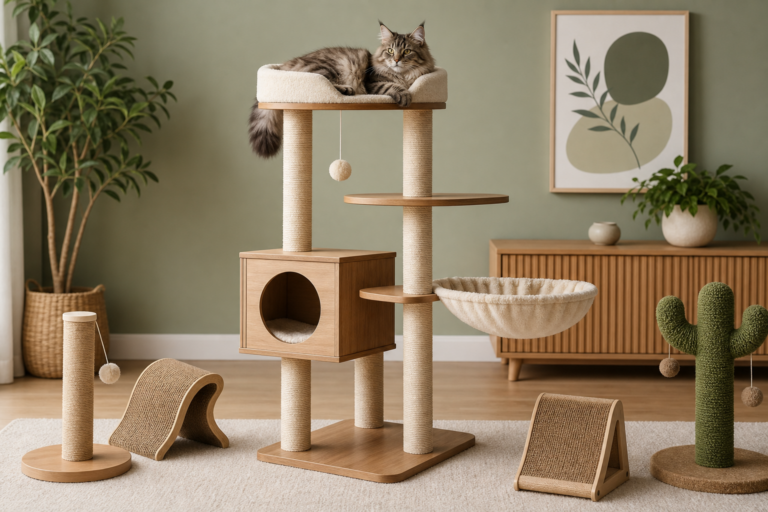
Cats feel most secure when they can survey their territory from above. Cat trees, wall-mounted shelves, and window perches fulfill this need and give indoor cats a sense of control over their environment. Positioning perches near windows — ideally overlooking a bird feeder or garden — turns a quiet afternoon into a live nature program. Climbing structures placed in rooms where the family spends time, rather than tucked away in unused corners, allow cats to remain socially connected while they observe.
Scratching Surfaces
Scratching is a multi-purpose behavior: it sharpens claws, stretches the spine and shoulder muscles, and deposits scent from glands in the paws, reinforcing a cat’s sense of ownership and security in their space. Offering a variety of scratching surfaces — sisal rope, corrugated cardboard, carpet-covered posts — in both vertical and horizontal orientations increases the chance that cats will use them rather than the furniture. Placement matters too: at least one scratching post near a sleeping area is useful, since many cats scratch as a stretching ritual immediately after waking.
Sensory Enrichment
Scent, sound, and taste can all deepen an indoor cat’s experience of their home. Dried catnip produces a temporary, harmless euphoric response in an estimated fifty to seventy percent of cats; silver vine and valerian root are effective alternatives for those that don’t respond. Some owners find that soft ambient music, nature sound recordings, or window-mounted bird feeders provide genuine entertainment. Fresh cat grass — wheat grass or oat grass — satisfies a nibbling instinct and gives cats a safe, living plant to interact with.
Catios and Supervised Outdoor Access
For cats that crave outdoor stimulation, enclosed outdoor structures known as catios offer a practical solution. These range from a window-box addition to a full backyard enclosure, providing fresh air and the sights, sounds, and smells of the outside world without the hazards of free roaming. Leash and harness training is another avenue for suitable cats, though it requires patient, gradual introduction and is not right for every temperament.
How Much Play Does an Indoor Cat Actually Need?
Veterinary guidance consistently favors short, frequent sessions over a single long daily marathon. Two to three interactive play sessions of roughly ten to fifteen minutes each works well for most adult cats; younger, more energetic cats may benefit from more. The natural peak activity windows for cats tend to be around dawn and dusk, making those good times to schedule sessions. Ending play with a small meal or treat capitalizes on the instinctive hunt-eat-groom-sleep sequence and typically results in a calmer, more settled cat afterward.
Recognizing the Signs of an Under-Enriched Cat
Some signals are easy to spot; others are subtle. Common indicators that an indoor cat’s environment needs improvement include destructive behavior such as furniture scratching or knocking objects off surfaces, excessive vocalization especially at night, aggressive play-biting toward people or other pets, repetitive over-grooming that leads to hair loss, and gradual weight gain from inactivity. Sudden behavioral changes always warrant a veterinary visit to rule out medical causes, but in many cases, structured enrichment forms a meaningful part of the solution.
FAQ
How do I get a sedentary or disinterested cat to engage with toys?
Start by experimenting with different movement patterns rather than different toys. Many cats respond to how a toy moves more than what it looks like. Try slow, ground-level movements with a wand toy, pausing frequently to let your cat lock on, then creating brief bursts of speed followed by stillness. For cats that have been inactive for a long time, starting with very short sessions of just a few minutes helps build engagement gradually without overwhelming them.
Are laser pointers safe and effective for cats?
Laser pointers can be a useful tool for initiating play, particularly with reluctant or highly mobile cats. The main concern is that cats can never physically catch a laser dot, which can leave them frustrated at the end of a session. The recommended approach is to always end a laser play session by pointing the beam onto a physical toy the cat can pounce on and hold, or by offering a small treat — providing the physical resolution that the hunt requires to feel complete.
My cat ignores expensive toys. Is something wrong?
Nothing at all. Cats are notoriously unpredictable in their preferences and frequently favor a crumpled receipt over an expensive electronic gadget. What engages a cat is unpredictable movement, interesting textures, and novelty — qualities that bear no relationship to price. Rotating even inexpensive toys in and out of regular use is more effective at sustaining long-term interest than continually purchasing new ones.
How should I adapt enrichment for a senior cat?
Older cats may have reduced mobility and stamina, but enrichment remains just as important for their well-being, and cognitive stimulation may help slow age-related mental decline. Puzzle feeders positioned at floor level, wand toy sessions at a gentler pace, window perches with ramps rather than jumps, and scent-based enrichment such as catnip or silver vine all work well. Predictable routines and close social time with their people are also meaningful forms of enrichment for senior cats.
Sources
- vcahospitals.com
- bestfriends.org
- parker-vet.com
- birdsbesafe.com
- adamsmarquetteveterinaryservice.com
- cherryhilldogcathospital.com
- centralkentuckyvet.com
Related Articles