Why Does My Cat Always Know? The Science Behind Feline Anticipation
Your cat isn’t psychic. She’s a pattern machine.
Cats figure out what you’re about to do the same way Pavlov’s dogs learned to drool at a bell: through association. Every time you open the dishwasher, pull out the carrier, or lace up your outdoor shoes, you run through a small sequence of behaviors before the main event. Your cat notices that sequence. After enough repetitions, just the first step is enough to trigger a response.
This is classical conditioning, and cats are very good at it. The science isn’t complicated. Stimulus A reliably precedes stimulus B, so over time, A alone produces the reaction normally reserved for B. No mind-reading required.
What they’re actually picking up on
When you’re about to do something, you do things you don’t notice you’re doing. You might always open a specific drawer before getting the flea treatment out. You probably grab the carrier from the same closet in the same way. You put on outdoor shoes before shopping trips and indoor slippers otherwise. Cats watch all of this, and they have the sensory hardware to catch cues you’d never think to hide.
A cat’s sense of smell is roughly 14 times stronger than a human’s, and they have nearly 40 times more odor-sensitive cells in their noses. That means they can detect subtle chemical differences — in your stress hormones, in what you’ve recently handled, in what you’ve opened. Their hearing extends well beyond ours, so a specific jingle of keys, the click of a particular cabinet, or the sound of a can opening in another room all carry distinct meaning.
They watch your body language more closely than you’d think, too. Research shows cats use human gaze as a referential signal — they track where your attention is directed. When you’re tensed up and hunting for the cat, you move differently than when you’re relaxed on the couch. They notice the difference.
Why one or two bad experiences is enough
Pretty Kitty only needed the flea treatment once or twice before she put the whole sequence together. That’s not unusual at all. Fear-based associations form much faster than neutral ones.
From an evolutionary standpoint, this makes complete sense. An animal that needs five exposures to learn “that smell means predator” doesn’t survive long. One or two exposures is plenty. The more unpleasant the outcome, the faster and more durably the association forms. Veterinary researchers who study how cats respond to carriers have noted that a single stressful vet trip can turn a neutral object into a flee-on-sight trigger for years afterward.
Long-term memory in cats is genuinely impressive. Some researchers believe cats can hold onto memories for the lifetime of the animal. Short-term memory is more limited — a 2017 Japanese study found cats could reliably recall where food was placed for roughly 15 minutes after the fact — but emotionally significant memories get consolidated into long-term storage fast. A stressful event isn’t just remembered. It gets flagged.
The internal clock: how they know it’s dinner time before you do
The feeding-time thing runs on a slightly different mechanism. Cats have a genuine circadian rhythm, a biological clock that nudges them toward activity around dawn and dusk — the crepuscular pattern left over from ancestral hunting behavior. But they also have what researchers call a food-entrainable oscillator: a separate internal timer that synchronizes to regular meal schedules.
Feed your cat at 6 pm every day, and their body begins ramping up hunger-related activity 15 to 20 minutes before 6 pm. No clock-watching required on their part. This is why cats start meowing for breakfast before your alarm goes off — their biological clock has synced to your household’s schedule at a level below conscious thought. The internal timer runs even during total food deprivation and resets gradually when meal times shift, which explains why switching feeding schedules takes a few days to stick.
What you can actually do with this
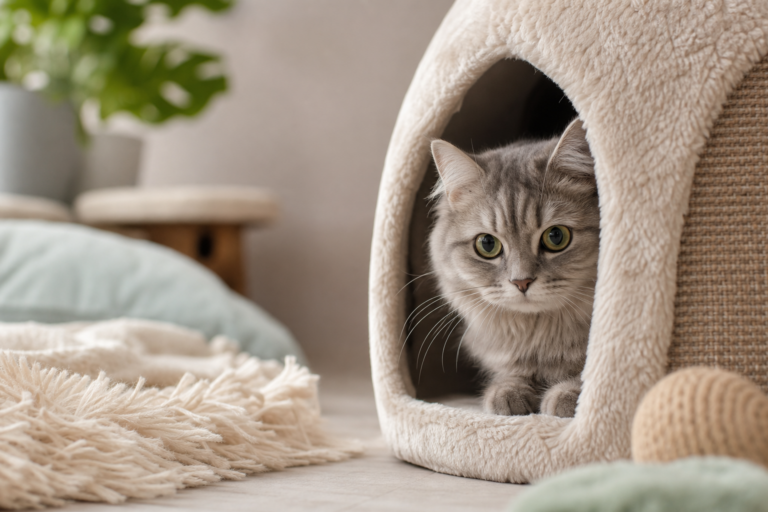
The most effective way to reduce pre-vet panic is to break the pre-action sequence. The carrier is the obvious place to start. When it only comes out of the closet on vet day, it becomes its own alarm bell. Leave it out permanently — put a blanket in it, let them nap in it — and it stops being a predictive signal. It becomes furniture.
The same logic applies to flea treatment. If you always retrieve the medication from the same spot, approach from the same angle, and adopt the same tense “I need to catch you” posture, you’re broadcasting the event before it starts. Mixing up the routine helps: handle the packaging without applying it, give treats from the same spot on off days. Each time a cue leads to something neutral, it erodes the cue’s predictive value a little.
A truly smart cat will eventually figure out the new routine too. But you can scramble the signal enough to buy yourself a few extra seconds, and for some cats that’s all you need.
Sources
- catvets.com
- psychologytoday.com
- en.wikipedia.org
- petmd.com
- scienceinsights.org
- pmc.ncbi.nlm.nih.gov
- cfa.org
- pawschicago.org
Related Articles