Cat Water Fountains: Do They Really Help Your Cat Drink More?
Many cats live in a state of mild, chronic dehydration — a fact that surprises owners who see a full water bowl sitting untouched for hours. If you have ever watched your cat ignore the dish and instead fixate on a dripping tap, there is an evolutionary reason for that behaviour, and it has real consequences for long-term health.
Why Cats Are Naturally Prone to Dehydration
The domestic cat descends from the African wildcat (Felis silvestris lybica), a desert-adapted predator that evolved to obtain most of its moisture from prey rather than actively seeking open water. Wild cats naturally get roughly 70% of their daily fluid needs from the meat they eat, leaving their thirst drive comparatively weak.
Indoor cats eating primarily dry kibble face a real mismatch. Dry food contains only around 10% moisture — nowhere near the approximately 70% found in whole prey or the roughly 80% in commercial wet food. Veterinary guidelines suggest that a typical cat needs around 50 ml of water per kilogram of body weight per day, which translates to about 200–250 ml for an average 4–5 kg adult. On a dry-food diet, that target is surprisingly difficult to reach through drinking alone.
The Instinct Behind Running Water
Cat water fountains capitalise on something rooted deep in feline behaviour. Cats appear to have a genetically wired preference for moving water, inherited from ancestors for whom a flowing stream represented relative safety. Stagnant pools in the wild were far more likely to harbour bacteria, parasites, and decaying organic matter than a running current — so natural selection favoured cats that treated still water with a degree of caution.
That ancestral wariness has not disappeared in the domestic cat. Their visual systems are finely tuned to detect movement, and the shimmer and trickle of flowing water catches their attention in a way that a static bowl simply cannot. Cats also appear sensitive to chlorine, a chemical routinely present in tap water, and the continuous filtration in a fountain reduces that chemical presence, making the water both smell and taste more appealing.
There is one additional behavioural quirk worth understanding: cats instinctively avoid drinking near their food. In the wild, a prey carcass close to a water source risked contaminating it. Many cats will consistently ignore a bowl placed next to their food dish, yet drink readily from an identical bowl elsewhere in the home. Placing a fountain well away from feeding areas removes this hidden barrier.
Do Fountains Actually Get Cats to Drink More?
For many cats, yes — but not for all, and the evidence is more nuanced than fountain marketing tends to suggest. Veterinary behaviourists note that the movement and sound of running water draws cats to drink more frequently throughout the day. The filtration systems built into most modern fountains — typically a combination of activated carbon and foam — also keep the water fresher between cleanings, reducing the off-putting smells that can build up in a stagnant bowl.
However, a survey of 549 cats examined through the Royal Canin Veterinary Academy found that more than 80% of the cats studied drank primarily from standard bowls, and the majority in that cohort actually preferred bowls to fountains. Nearly 60% supplemented their drinking from entirely unconventional sources — garden pots, watering cans, puddles. Cats are decidedly individual in their preferences. A fountain can transform one cat’s drinking habits dramatically, while another may ignore the bubbling contraption indefinitely.
The practical conclusion: a fountain is a genuinely useful tool for encouraging hydration, particularly for cats who show a natural interest in running water, but it is one option among several rather than a guaranteed universal fix.
Why Hydration Matters More Than You Might Think
The health stakes behind this seemingly small lifestyle decision are significant. Kidney disease is among the most common conditions affecting domestic cats, with risk rising sharply in middle-aged and senior animals. When urine becomes persistently concentrated due to insufficient water intake, the kidneys must filter a heavier mineral load — conditions that promote the formation of crystals, stones, and inflammation in the urinary tract. Cornell University’s College of Veterinary Medicine emphasises that dehydration can actively accelerate damage in cats already living with chronic kidney disease (CKD), making adequate hydration a front-line management strategy rather than a minor lifestyle detail.
Urinary tract problems — painful cystitis, bacterial infections, and potentially life-threatening urethral blockages — are also closely tied to how dilute or concentrated a cat’s urine is. Well-hydrated cats produce more dilute urine that flushes the bladder more effectively, reducing the conditions in which pathogens and mineral deposits take hold. For male cats in particular, who are anatomically more vulnerable to obstructions, sufficient water intake can be genuinely life-saving.
Choosing and Maintaining a Fountain
If you decide to try a fountain, a few practical factors are worth considering before you buy.
- Material: Stainless steel and ceramic are the most hygienic choices. Plastic develops micro-scratches over time that harbour bacteria and may trigger feline chin acne in sensitive cats.
- Filter design: Most fountains use activated carbon combined with a foam pre-filter. Filters should typically be replaced every two to four weeks; the entire unit needs thorough disassembly and cleaning approximately once a week to prevent biofilm — a bacterial slime layer — from building up in the pump and channels.
- Flow style: Some cats are attracted to a gentle central bubble; others prefer a freefall cascade or a tap-like stream. Many cats initially investigate a fountain with a paw rather than their mouth, so allow several days before concluding your cat has rejected it.
- Pump safety: Look for an auto shut-off feature that cuts power if the water level drops below the minimum — running a pump dry is the most common cause of fountain failure and can also pose a safety risk.
- Placement: Position the fountain well away from food bowls, and in multi-cat households consider one fountain per cat to reduce competition.
A Broader Hydration Strategy
A fountain alone is rarely enough if a cat is significantly under-hydrated. The most effective approach combines several tactics:
- Incorporate wet food. Even replacing one dry-food meal a day with a wet alternative can meaningfully increase total daily moisture intake, since wet food is roughly 80% water.
- Offer multiple water stations. Place bowls or fountains in several locations throughout the home, always well away from feeding areas.
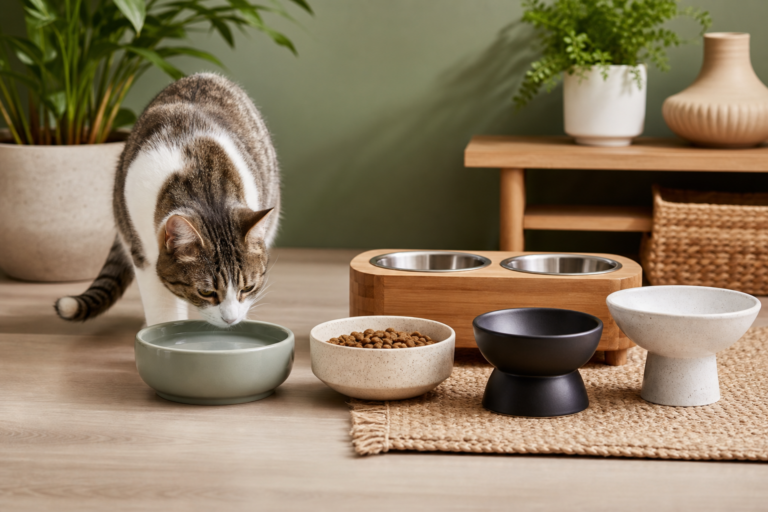
- Choose wide, shallow vessels. Cats dislike whisker fatigue — the discomfort caused when sensitive whiskers brush the sides of a narrow bowl. A wide, shallow dish removes this deterrent.
- Refresh water daily. Even without a fountain, changing still water at least once daily, and ideally twice, keeps it more appealing.
- Consider filtered water. If your tap supply is heavily chlorinated, some cats will drink noticeably more from filtered or lightly chilled water.
FAQ
How can I tell if my cat is drinking enough water?
A well-hydrated cat produces pale to almost colourless urine. Dark, strong-smelling urine is a sign of concentration and a prompt to encourage more drinking. Physical signs of dehydration include dry or tacky gums, reduced skin elasticity (the skin at the scruff does not spring back immediately when gently lifted), and unusual lethargy. If you are concerned, your vet can assess hydration status quickly during a routine examination.
Is it safe to leave a cat fountain running all day?
Yes, provided the water level stays above the minimum line marked on the unit. Most modern fountains include an auto shut-off to protect the pump motor if water runs low. Checking the level daily and topping it up as needed is the single most important maintenance habit for keeping a fountain running safely over the long term.
Can a fountain help a cat with kidney disease?
Encouraging greater fluid intake is a well-established part of managing feline chronic kidney disease, and a fountain can be a useful part of that effort. However, cats diagnosed with CKD need veterinary supervision, and their hydration requirements may go beyond what a fountain alone can address — some cats with advanced disease require subcutaneous fluid therapy administered at home. Always discuss hydration strategies with your vet if your cat has a kidney diagnosis.
Do I still need a water bowl if I use a fountain?
Keeping at least one conventional bowl available is a sensible backup, particularly during power outages or when the fountain is being cleaned. In multi-cat households, a bowl also ensures every cat has access to water even if one individual has claimed the fountain as their own. Some cats will simply continue to prefer a bowl regardless of how appealing the fountain appears to their housemates.
Sources
- zoetispetcare.com
- vet.cornell.edu
- petmd.com
- guardianveterinaryspecialists.com
- cats.org.uk
- academy.royalcanin.com
- catster.com
- siriusvets.com
Related Articles