From Tiny to Terrific: Kitten Growth Stages from Newborn to One Year
Few transformations in the animal world match the pace and drama of a kitten’s first twelve months — a compact window in which a creature born blind, deaf, and no bigger than your palm becomes a fully capable, socially wired feline. Understanding these growth stages helps owners and caregivers provide exactly the right support at exactly the right time.
Stage 1: The Neonatal Period (Weeks 0–2)
A kitten arrives in the world profoundly underprepared for it. Newborns typically weigh between 85 and 115 grams — roughly the weight of a large egg — and are born with both eyes and ear canals sealed shut. They cannot regulate their own body temperature, which means they depend entirely on their mother, or for orphaned litters on a warm environment held around 85–90°F, to survive.
During this phase a healthy kitten’s entire repertoire consists of nursing, sleeping, and mewing. One reliable marker of good health is steady weight gain: a thriving newborn puts on roughly 10–15 grams per day and may even double its birth weight within the first week. If growth stalls or reverses, it can signal fading kitten syndrome, a leading cause of early mortality that warrants immediate veterinary attention.
Stage 2: Transition and Early Exploration (Weeks 2–4)
Between seven and fourteen days the eyes begin to open — at first as narrow blue slits, then widening to reveal a world the kitten can barely interpret. Vision in these early days is extremely limited but improves rapidly. Ear canals follow a similar timetable, usually unsealing around the end of the first week and becoming fully functional over the following weeks. By the time a kitten is three weeks old it is experiencing genuine sight and sound for the first time.
Mobility arrives on shaky terms. First steps typically appear around weeks two to three, progressing from wobbly lurches to surprisingly confident trotting by weeks four to five. Deciduous (baby) teeth begin pushing through the gums around week three, starting with the incisors. By week four, claws become retractable and kittens begin voluntarily using a litter box — usually by watching and mimicking their mother.
One often-overlooked milestone: around four weeks kittens gain the ability to thermoregulate independently, marking a significant step toward self-sufficiency.
Stage 3: The Critical Socialization Window (Weeks 4–12)
If there is a single developmental period with the most lasting impact on a cat’s lifelong personality, it is the socialization window running roughly from four to twelve weeks. During this time kittens are uniquely receptive to forming positive associations with people, other animals, and new environments. Feline behaviorists consistently find that kittens who receive gentle daily handling and varied exposure during these weeks grow into more confident, people-friendly adult cats. Those deprived of positive human contact before around seven weeks tend to be significantly harder to socialize later in life.
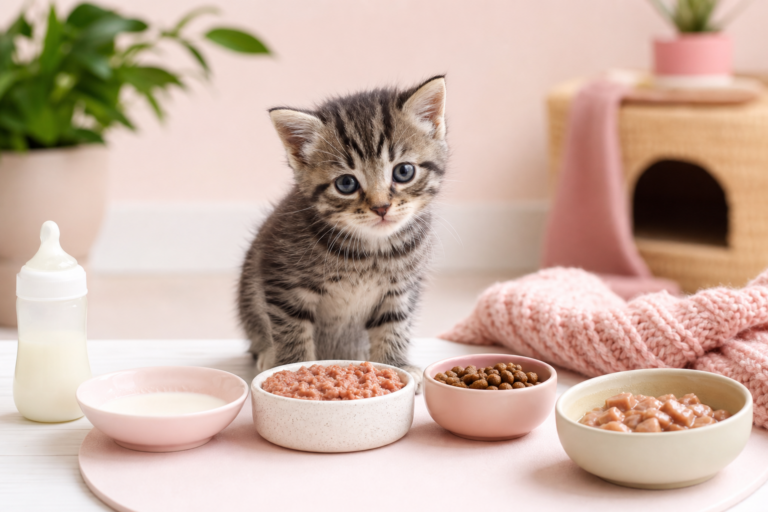
This stage also brings weaning. Kittens typically begin transitioning from mother’s milk to solid food around four to five weeks, with wet kitten food or moistened kibble introduced gradually. By weeks seven to eight most kittens are fully weaned and eating solid food exclusively. All twenty-six baby teeth are generally present by week eight.
Eye color also settles during this period. The blue tint present in nearly all newborn kittens shifts toward the permanent adult color — green, amber, gold, or combinations thereof — by around six to eight weeks of age.
Veterinary Care During the Socialization Stage
Health care should begin early. Deworming is typically recommended starting at two weeks, with repeat treatments every two weeks thereafter. The first core vaccination — the FVRCP shot, covering feline distemper, viral rhinotracheitis, and calicivirus — is generally given between six and eight weeks. A booster follows three to four weeks later, and the rabies vaccine is introduced around twelve to sixteen weeks depending on the veterinarian’s protocol and local regulations.
Stage 4: The Juvenile Phase (3–6 Months)
By three months a kitten has left the neonatal and early socialization stages behind and entered a period that closely resembles feline adolescence. Energy levels are high, play is intense, and coordination has matured to the point where the kitten can run, leap, and ambush with real precision. Body weight at twelve weeks typically falls between 900 grams and 1.4 kilograms, though this varies considerably by breed.
Around four months the deciduous teeth begin to fall out and permanent adult teeth take their place — a process generally complete by six months. Owners may notice their kitten chewing more vigorously or occasionally find tiny shed teeth around the house.
Sexual maturity can arrive earlier than many owners expect. Female kittens can enter their first heat cycle as early as four to five months in some breeds, and males may begin scent-marking behavior around six months. For this reason, many veterinarians recommend spaying or neutering by six months of age, with some advocating for earlier procedures depending on the individual kitten’s size and health.
Stage 5: Adolescence and the Road to Adulthood (6–12 Months)
The six-to-twelve-month phase is adolescence in the truest sense: the body is approaching its adult dimensions while behavior often remains strikingly kittenish. Many cats in this stage test boundaries, engage in vigorous play-hunting, and display bursts of seemingly random energy — the classic late-night “zoomies.” Social hierarchies in multi-cat households often begin to crystallize during this window as cats figure out their place in the group.
By the first birthday a cat is conventionally classified as an adult, and nutrition should shift from high-calorie kitten food to an appropriate adult formula. That said, full behavioral and cognitive maturity typically continues until around eighteen months — meaning that a one-year-old cat may still act very much like a teenager long after its official adult classification.
Key Milestones at a Glance
- Birth–2 weeks: Eyes and ears sealed; entirely dependent; healthy gain of 10–15 g per day.
- Weeks 2–3: Eyes and ears begin to open; first wobbly steps attempted.
- Week 3: Baby teeth emerge; purring begins.
- Week 4: Thermoregulation established; claws retract; litter box use begins.
- Weeks 4–8: Critical socialization window; gradual weaning; first vaccines at 6–8 weeks.
- Week 8: All 26 baby teeth present; eye color shifting toward adult hue.
- Weeks 10–12: Optimal adoption age — fully weaned, vaccinated, and socially prepared.
- 4 months: Adult teeth begin replacing baby teeth.
- 6 months: Spay/neuter typically recommended; near-adult body size in many breeds.
- 12 months: Official adult status; transition to adult cat food.
FAQ
When can a kitten safely leave its mother?
Kittens learn critical feline behaviors from their mother and littermates well into their tenth week. Most behaviorists and veterinarians recommend waiting until at least ten weeks, with twelve weeks considered the gold standard — by which point a kitten is fully weaned, litter-trained, vaccinated, and socially developed. Separation before seven weeks is associated with higher rates of anxiety and behavioral difficulties in adult cats.
Why are my kitten’s eyes still blue at eight weeks?
Blue eyes in young kittens result from the absence of melanin pigment in the iris, not from a gene for permanent blue coloring. The final adult color typically settles between six and ten weeks, though some individuals shift more slowly. If a kitten’s eyes remain blue past twelve weeks, it may simply carry adult blue-eye genetics — as certain breeds like Siamese and Ragdolls do — or the adult color may be a pale shade that is still developing.
How often should a young kitten eat?
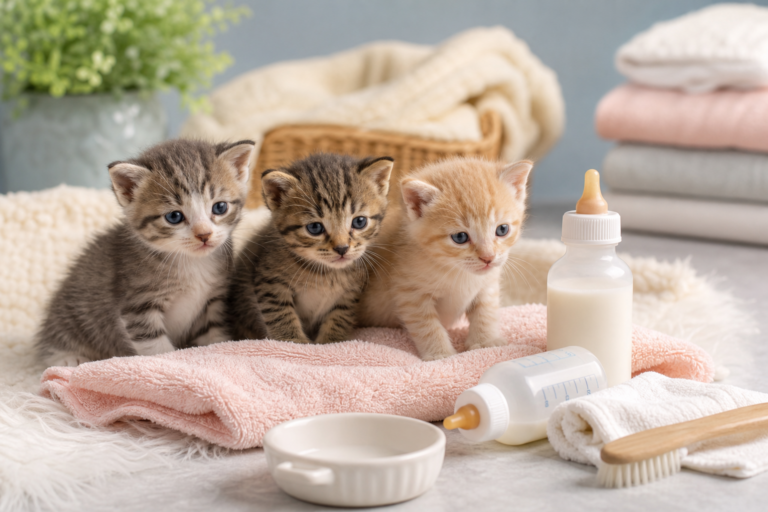
Orphaned neonates need bottle feeding every two to five hours around the clock. Once weaning begins at four to five weeks, kittens can be offered wet food up to four times daily. From around three months, three meals a day is typical, and by six months most kittens comfortably manage two scheduled meals, potentially supplemented with access to dry food, though your vet’s guidance should always take precedence.
When should I schedule the first vet visit?
The first veterinary visit is ideally booked at six to eight weeks of age, coinciding with the first round of core vaccinations. This appointment also gives the vet an opportunity to check for congenital issues, parasites, and early illness. Follow-up visits for booster shots are typically scheduled at twelve weeks and again around sixteen weeks, establishing a pattern of annual wellness visits that continues throughout the cat’s life.
Sources
- petmd.com
- hillspet.com
- primacat.com
- thecattitudecentral.com
- sheba.com
- almontecats.com
- switzerlandanimalhospital.com
Related Articles